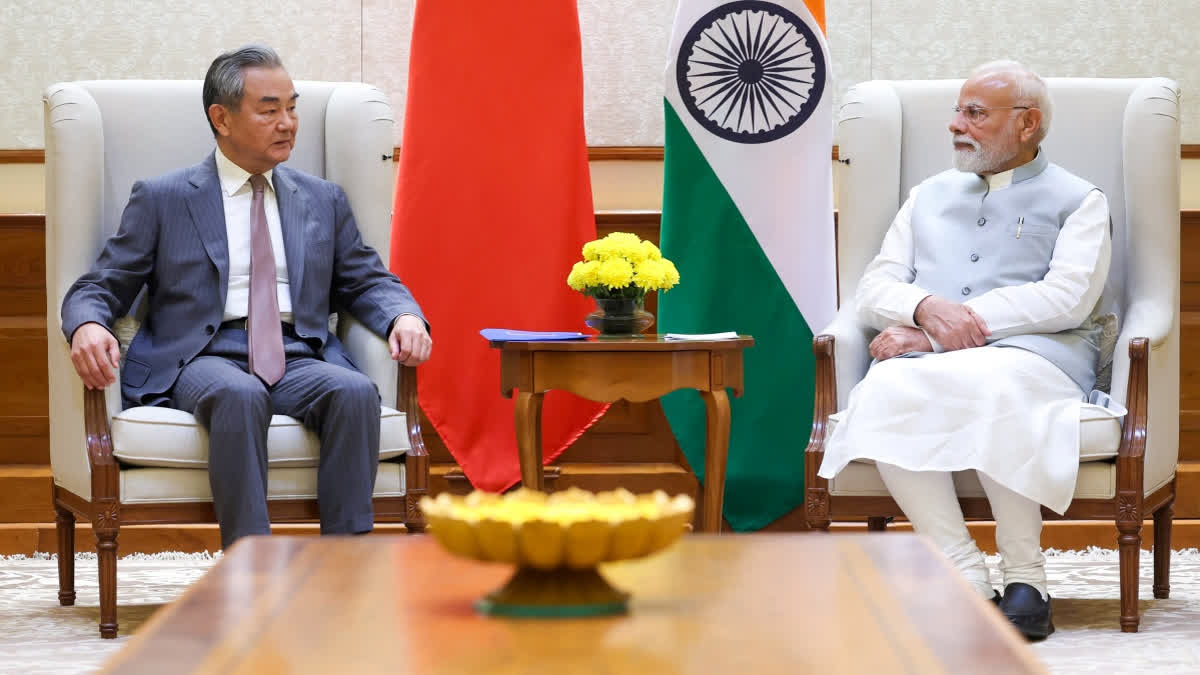
At the invitation of India’s National Security Adviser Shri Ajit Doval, the Member of the Political Bureau of the Communist Party of China’s Central Committee and Minister of Foreign Affairs of China Wang Yi paid an official visit to India (August 18-19) to co-chair with India’s NSA Ajit Doval the 24th round of the Special Representatives’ (SRs) Dialogue on the Boundary Question between India and China-a mechanism which was set up in 2003 to address the complex issue of border settlement between the two countries.
During his stay, the Chinese Foreign Minister also met External Affairs Minister Dr S. Jaishankar and called on Prime Minister Modi of India. Wang Yi’s visit is one in the series of steps being taken slowly but steadily towards full normalisation of relations between India and China, which deteriorated severely following the fatal violent clashes between the Indian and Chinese soldiers in June 2020 in Galwan Valley along the Line of Actual Control.
The thaw in relations between India and China, it may be recalled, began, after a hiatus of more than four years, with the official announcement on 21 st October 2024 that India and China had reached an understanding on “patrolling arrangements along the Line of Actual Control in the India-China border areas, leading to disengagement and a resolution of the issues that had arisen in these areas in 2020”.
In the last ten months since the announcement, India and China have had important high-level exchanges, including at the level of Foreign and Defence Ministers, and have also announced a series of symbolic yet important decisions such as the appointment of the Chinese Ambassador, resumption of the Kailash Mansrover Yatra for Indian pilgrims, resumption of direct flights etc. PM Modi is likely to meet with President Xi Jinping in China on the sidelines of the SCO Summit end August this year.
Opinions differ on the current pace of rapprochement. The strategic community in China is of the opinion that India is not doing enough to improve bilateral relations. While the thaw in relations has been generally welcomed in India, the need to tread with caution has also been underlined. Trust deficit continues to persist for justifiable reasons.
For instance, within 10 days of the restart of boundary negotiations, China announced the creation of two new counties, including on the Indian territory in Aksai Chin illegally occupied by China; further, end of December 2024, China announced its plan to build a mega Dam on the river Brahmaputra in the ecologically sensitive region of Tibet. The possibility of China weaponising water in future cannot be ruled out.
Meanwhile, as a matter of important and somewhat unexpected development, India’s relations with the US are witnessing signs of stress caused largely by President Donald’s extremely offensive attitude towards India on trade and tariffs. He has, in a way, questioned India’s strategic autonomy by imposing tariffs and penalties on India for buying oil from Russia, ignoring US unilateral sanctions on Russia.
Donald has done so despite the fact that both the USA and its European allies continue to do trade, howsoever small, with Russia. Further, Trump, in a policy reversal, has decided to reset US relations with Pakistan, whom he, in his previous term, had accused of lying and deceiving the USA while receiving billions of dollars in foreign aid.
It is a matter of separate debates as to what are Trump’s compulsions are in re-engaging Pakistan or creating irritants in the US relations with India. It is clear, however, that Trump’s attitude towards India at the moment is obviously not in tune with the “global comprehensive strategic partnership” which India and the USA have developed painstakingly over the last two decades. Further, Trump is also sidestepping the bipartisan support which India has enjoyed in the USA amongst both Republicans and Democrats for decades.
In short, in the last few months, two clearly discernible trends have emerged: on the one hand, India’s strained relations with China, which nose-dived in 2020, appear to be on the trajectory of normalisation; on the other hand, India’s strong and close relations with the USA are witnessing minor cracks.
Certain analysts appear to be erroneously linking these two trends in suggesting that India should accelerate the process of improvement of relations with China to send a message to the USA. It must be underlined that India’s decision to normalise relations preceded the beginning of the downslide in relations between India and the USA by several months and was based on its own merit.
India is therefore likely to regulate this process, guided largely by the bilateral rather than extraneous considerations. As far the USA, India in all probability is likely to exercise restraint till the outcome of Trump’s efforts to bring about a peace deal between Russia and Ukraine is known. In case the conflict is resolved, the US and European sanctions on Russia are likely to get lifted/relaxed in which scenario Donald will have no argument to justify the imposition of penalties on India for doing business with Russia.
If that doesn’t happen, India will nevertheless find ways to tide over the situation created by Trump’s arbitrary decisions. In any case, under no circumstances, India is likely to yield to any pressure or compromise with its strategic autonomy or sacrifice its national interests.